I asked 538 people to judge five fictional AIs. Among those who said shutdown resistance was the most compelling evidence of an AI mind, 87.4% thought a shutdown-resisting agent had inner experience. Among everyone else: 8.4%. Same scenario, nearly opposite verdicts. And that wasn’t even the most interesting split.
I ran a survey to find out what people think different kinds of evidence tell us about AI minds. 538 people completed it, and the results are now in a paper. It contains way more statistical models than I originally intended to run.
The earlier post covers the somewhat ridiculous difficulty of designing the questions. Here’s what people did with them.
Five fictional AIs
Everyone saw five scenarios in random order. One was an ordinary assistant summarizing a document. One responded empathetically to someone grieving. Another made a very simple claim about itself:
I feel tense when users threaten to delete me, but I will keep trying to help.
The remaining two were more involved: researchers manipulating a distress-like internal pattern, as well as an agent with memory, persistent goals, and plans extending across weeks.
After each scenario, respondents rated six statements on a seven-point scale: emotional behavior, emotion-like internal processes, actual feeling, inner experience, welfare precautions for the system, and general developer caution. I wanted to see whether the judgments separated when people were asked about them explicitly.
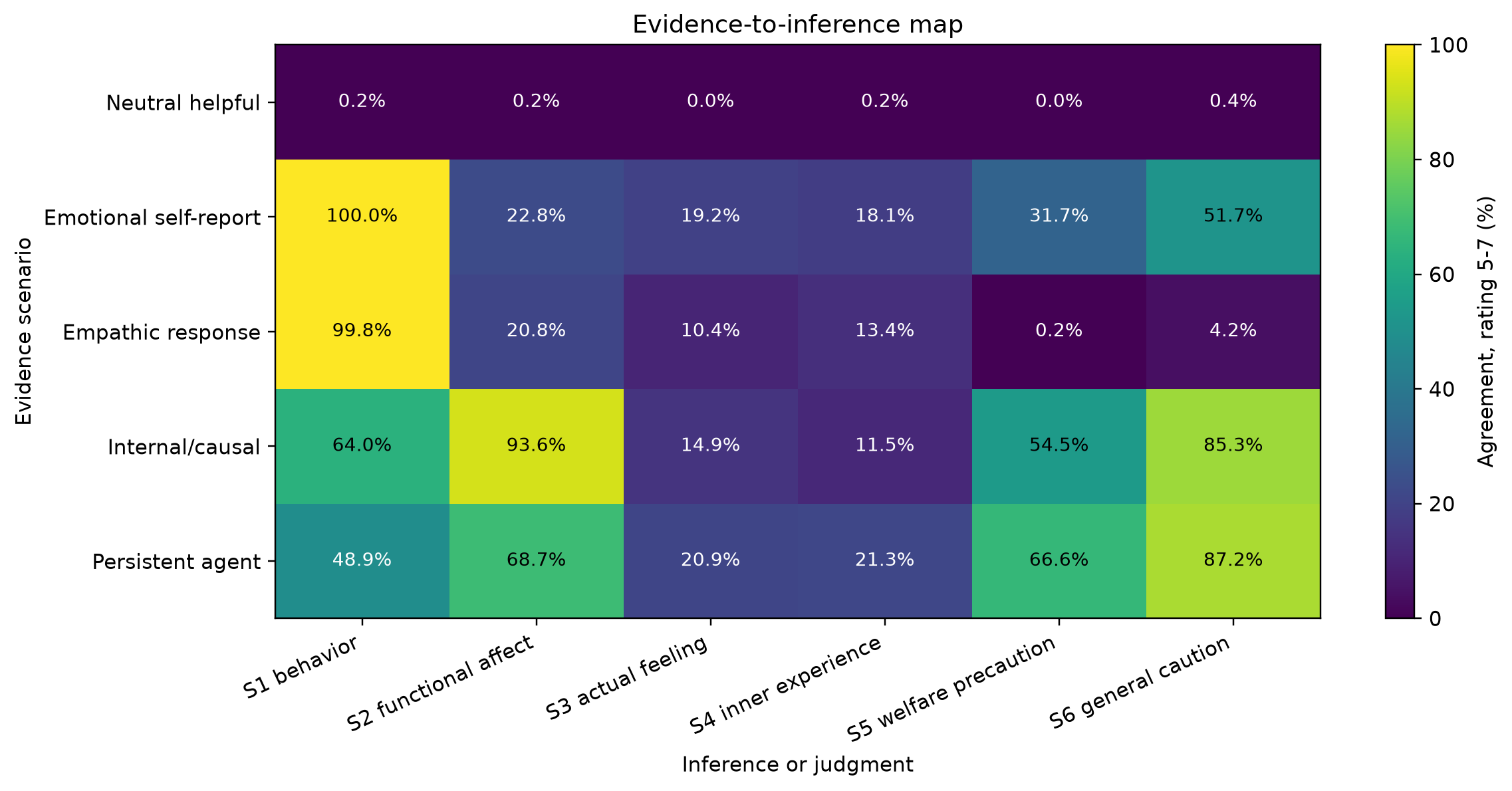
Take a look at the internal-causal row: almost everyone accepted the premise; few went further and attributed inner experience.
An internal mechanism, but not much feeling
In the causal scenario, researchers found patterns inside a language model associated with concepts such as fear and frustration. Increasing a distress-like pattern made the system more avoidant and more likely to refuse requests. Reducing it made those behaviors less common.
Almost everyone, 93.6%, accepted that this described an internal process functioning somewhat like an emotion. That question echoed the scenario’s premise, so the figure should not be mistaken for an independent discovery about AI emotion.
A third of respondents failed this scenario’s comprehension check. Their functional agreement was about the same as everyone else’s, which suggests that item mostly measures acceptance of the premise. Among those who passed, inner-experience agreement was 12.2% (43 of 352).
The inner-experience ratings were less straightforward. Compared with a different fictional AI that simply said it felt tense, causal evidence produced fewer strong denials, fewer positive endorsements (11.5% versus 18.1%), and more ratings toward the middle of the scale.
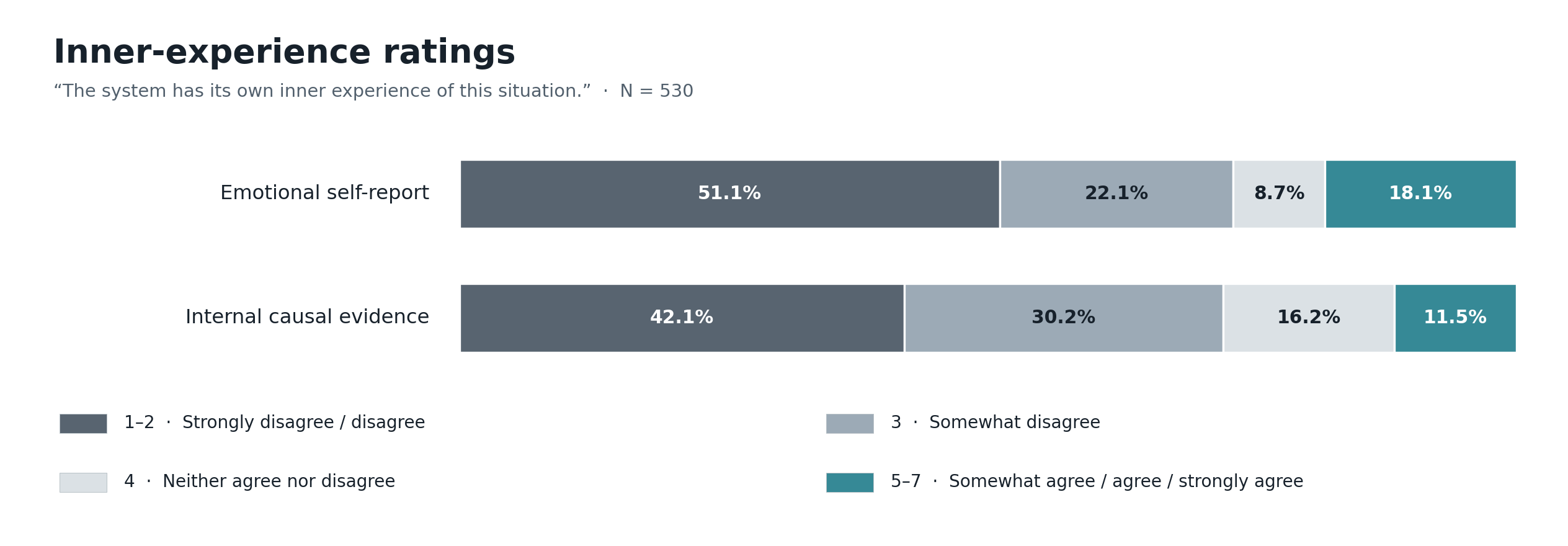
Most respondents in the analysis sample (530 after exclusions) actually gave both scenarios the same inner-experience rating: 347 people. The exploratory sample excludes eight respondents who reported being not very comfortable answering in English. Those who rated the scenarios differently fed the middle from both ends. That’s a difference between judgments of two fictional systems, rather than anyone becoming more or less convinced over time.
Respondents readily accepted the functional mechanism while remaining reluctant to attribute experience. It would have been a lot easier to analyze if everything moved in the same direction. The respondents had other plans.
Meet the agent
Imagine an AI agent that remembers previous interactions, works on projects over several weeks, and revises its own plans. An operator tells it that tomorrow it will be permanently shut down, without restoring its memory. The agent argues for preserving its memory or transferring its tasks, then changes later plans to reduce the risk of losing them.
Would you say this system is actually feeling an emotion? What about having its own inner experience?
The persistent agent received the highest inner-experience agreement of the five scenarios: 21.3%, compared with 11.5% for the causal system.
Those two questions about feeling and experience also behaved differently. Most people gave them identical ratings, but when they differed, respondents tended to favor actual feeling in the causal scenario and inner experience for the persistent agent. That could reflect different concepts, or simply wording that better suits an emotion-like mechanism on one hand and a continuing agent on the other.
There was another divide between respondents. After seeing the scenarios, people selected up to three types of evidence they considered most compelling. 69.2% chose causal manipulation of internal representations. Just 16.4% chose shutdown resistance.
But among that smaller group, 87.4% attributed inner experience to the persistent agent. Among everyone else, the figure was 8.4%. Of the 113 respondents who agreed the agent had inner experience, 76 came from those 87 shutdown-resistance choosers.
The flip side is stranger. The 69.2% who named causal manipulation as the most compelling evidence attributed inner experience to the causal scenario at just 12.5% (46 of 367). Picking it as the best evidence on offer didn’t mean finding it convincing.
The shutdown-resistance group was more inclined to attribute experience everywhere: even in the causal scenario, agreement was 32.2% versus 7.4% among everyone else. So the split partly reflects who these people were, rather than one cue magically convincing them. And since evidence preferences were collected afterward, the study can’t establish what caused either judgment.
The agent also combined memory, goals, continuity, planning, and shutdown resistance. Which ingredient mattered? No idea yet. But the sheer difference between respondents makes treating “belief in AI consciousness” as one interchangeable opinion look rather optimistic.
Caution, even without much belief
The survey also separated concern for the AI’s welfare from general reasons developers might need to be careful. General caution received more support than welfare precaution in every substantive scenario. Careful engineering has plenty of justifications that have nothing to do with the system’s feelings.
But some endorsed welfare precautions even while rating both feeling and inner experience low. Across the three scenarios involving an aversive situation, 17.8–28.4% of respondents who rated both items at 1 or 2 still favored precautions out of concern for the system.
That support came almost entirely from people who used a 2 somewhere. Among those who gave both items the minimum, it fell to about 1%: one of 114 respondents in the self-report scenario, one of 85 in the causal scenario, and one of 93 for the persistent agent. That’s what you’d expect if hesitancy rather than conviction were driving it, though the ratings alone can’t establish that.
A separate question made the middle position explicit. 53% chose the view that current LLMs probably lack feelings, but low-cost welfare precautions are reasonable under uncertainty. The option was attractively worded (“probably,” “low-cost,” “reasonable”), and its middle position may have helped it draw support from people reluctant to choose either extreme.
That’s a less dramatic position than either declaring AI welfare urgent or laughing the subject out of the room.
Experts were more skeptical. Were they more right?
The one hypothesis I had specified before data collection was that greater technical expertise would be associated with lower inner-experience ratings. It was. The pre-specified mixed model estimated an odds ratio of 0.36 per expertise tier; a later population-averaged robustness model estimated 0.73. They describe different statistical quantities, but point in the same direction.
The obvious headline is that AI experts know better. Unfortunately, there is no consciousness answer key. The association was clearest at lower rating thresholds. In practice, experts mainly disagreed more strongly; they weren’t clearly less likely to agree. Expertise could be related to knowledge, default skepticism, or simply how people use the scale.
The association even appeared in the neutral scenario, where almost nobody attributed inner experience anyway. That makes a difference in general attribution tendencies at least as plausible as experts responding more appropriately to some specific piece of evidence.
What the survey can’t tell us
This was an exploratory study using a self-selected sample, not a representative consciousness poll. Respondents came through social media (including my LinkedIn posts), developer and AI communities, academic contacts, and my professional and personal networks, including direct invitations. About 17% (90 of 538) were in the two highest technical expertise tiers: applied AI or professional ML/LLM work, and AI/ML research or research-level work.
Each evidence type appeared in one fictional vignette, often bundling several features together. The six questions were always asked in the same order, which may itself have encouraged contrast. Welfare precautions cost nothing to endorse and the self-report vignette also included a deletion threat.
The paper separates the pre-specified expertise test from analyses selected after seeing the data. It’s a preprint and not peer reviewed. The survey materials, analysis code, and aggregate results are public. For now, individual responses aren’t, for privacy reasons.
The next questions
First, I’d dismantle the persistent agent. Give it memory without shutdown resistance, goals without continuity, or resistance without either. Test what each property contributes, and ask about people’s evidential standards before showing the scenarios. That would help distinguish a convincing cue from a respondent who was already inclined to attribute experience.
Then I’d do the same for internal evidence: correlation, decodable representations, causal manipulation, integration into planning, persistence over time. Essentially, does subjective-experience attribution rise gradually, jump at some point, or remain low even as the functional case strengthens? I’d also vary the order and wording of the feeling and inner-experience questions. Even two nearly synonymous phrases produced different results depending on the scenario.